
Over the weekend, the very right-wing, pro-Russian AfD party won an election in the German State of Sachsen-Anhalt, in the former East Germany. This is a development that is likely to have major and lasting implications for all of Europe, shaking as it does the politics of the EU’s single most important member state to its core.
There are many explanations for the AfD’s triumph, few of them particularly controversial: First, that there would be no AfD without immigration levels as they have been in Germany and Europe over the last decade. Second, massive pressures on the cost of living, driven in large part by Germany’s decision to prioritise climate compliance over economic growth. Third, and perhaps a bit banal, the fact that East Germany retains a large Russian-sympathising and eastern-oriented population, dating in part to East Germany’s time as perhaps the crown jewel of the Soviet satellite states, making the AfD much more of an East German than West German phenomenon.
Indeed, the political divisions between East and West Germany should be clearly understandable to an Irish person: Explaining why the AfD’s pro-Russian, anti-immigration views are stronger in Sachsen-Anhalt than in Frankfurt or Bavaria is like explaining why the DUP is stronger in North Antrim than it is in West Cork. Demographics and history and partition matter.
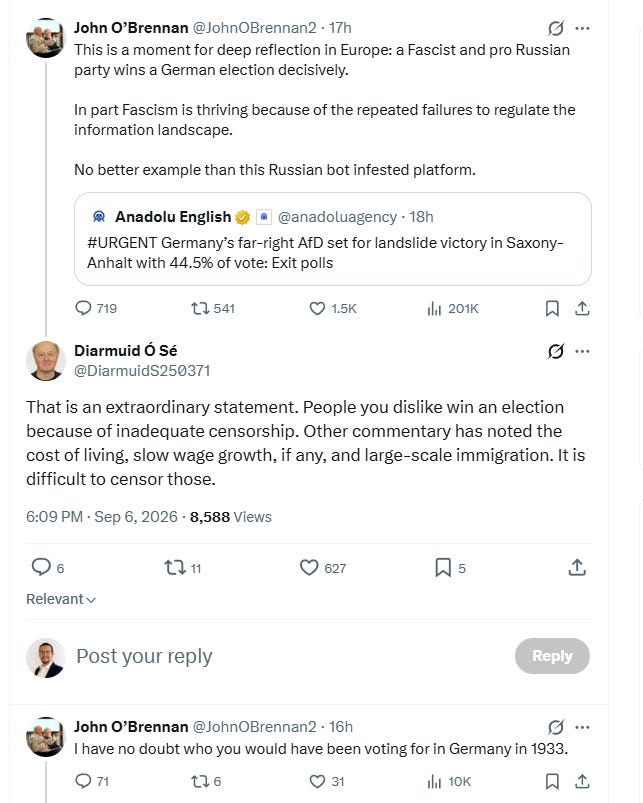
In any case, there’s a lot for academics and political scientists to get their teeth into, from the weekend’s result. This is what academics are paid to do: To enhance our understanding of the world, and what has just happened in it. Which brings us to one of Ireland’s most prominent academics, Professor John O’Brennan of Maynooth. I am taking the liberty of posting his reaction to the AfD’s triumph here, and his response to a person who criticised him for it:
O’Brennan is not an ordinary academic. His seniority is denoted by the fact that he holds the prestigious, EU-backed Jean Monnet Chair in European Integration at Maynooth. He is charged with moulding the next generation of young minds, and producing the people who will provide the intellectual underpinnings of Irish society long after you and I, dear reader, are in our dotage.
And yet there is a basic problem: He says inordinately stupid things, all the time.
In general, it is important not to get personal when you write about others. Yet there are times when some things must be stated clearly, and this is one such case: O’Brennan is engaged here, nominally, in academia. His authority to speak comes from his supposed expertise.
Yet this intervention displays neither the intellectual curiosity nor the temperament required to analyse information objectively. His public utterances, of which the above is merely the latest, show us an intemperate, silly man without the capacity to respond to even mild challenge in any kind of persuasive way.
Let’s break it down: First, his immediate instinct in response to a democratic election is to reach not for any of the more obvious explanations, but to go straight to a “failure to regulate the information landscape”. Not, you’ll note, any of the factors listed above: Not migration. Not the cost of living. Not even “eastern Germany has a historically much more Russia-sympathetic political culture”, which would be simplistic but at least relevant.
No, the contribution O’Brennan chooses to make is: The information landscape was not regulated.
This is less an observation, of course, than it is an admission: O’Brennan does not believe that the AfD – or other European Parties like them – can be defeated in a fair fight. Instead, he demands that the news landscape be highly regulated in order to suppress rather than to amplify their message.
One might note, incidentally, that this has already been tried, obsessively, by European regulators. The EU has funded “fact-checkers” for years, and put extreme pressure on Facebook and other platforms for years after Brexit to ensure that nothing like it could ever happen again. Even now, the Digital Services Act already provides precisely the kind of extensive regulation of the online information landscape for which O’Brennan is calling. It hasn’t worked.
Second, there is what it says about O’Brennan’s mind: The genuinely interested academic and political scientist might look beyond an immediate partisan reaction to an election result to try and figure out what has just happened – but not the good Professor. In his mind, the first question to be asked is not “why did this happen?” but “how can we ensure it never happens again?”
Ironically, “why did this happen?” is exactly the question he should be asking, if he wants to answer the second.
And third, we come to his response to a perfectly legitimate response: A reader tells him that there may be other factors behind the election result, and O’Brennan says “I have no doubt who you would have been voting for in Germany in 1933.”
In other words: Disagree with me, and I will suggest that you would have voted Nazi in 1933.
This buffoon – for that is what he is – has no place in any academic institution. He lacks any curiosity, let alone decorum.
I will not say here that Irish academia is full of such people. That would be unfair, because the whole point of this piece is that there are few, if any, worse than O’Brennan. But we can say this: Irish academia is full of people who tolerate the O’Brennans of this world, and who say nothing of public conduct like this.
It is full of people, in fact, who celebrate it. The depressing suspicion invited by interventions like this is that, in some corners of academia, holding the approved opinions may matter rather more than displaying the intellectual curiosity supposedly required to interrogate them.
For this service to the production of endless establishment guff, he occupies a publicly funded professorship at Maynooth. The university’s current professorial salary scales begin comfortably above €100,000. And here he is, responding to mild disagreement by suggesting that his critic would have voted Nazi in 1933.
He’s paid, is John O’Brennan, for his brain. The Government gives him a very good salary for it. I wouldn’t give tuppence.
JMG
Great piece. The mainstream media is really missing a trick by not giving space to this kind of analytical opinion writing. Instead it sticks to the traditional column, which talks in generalities and takes too long to say very little.
As for O’Brennan, what an extraordinary display of ignorance. I’m yet to see how Twitter has been anything but a disaster for academia. It has exposed so many academics as being intellectually and temperamentally demented.
There was once a very sharp divide between the nuanced opinions of the establishment and the crudities of populists. O’Brennan represents a new departure: the progressive establishment is being forced to adopt ever more ridiculous explanations for why they are losing support. Could it be any clearer that their ideology is at crisis point?
Had some interaction with him last night - for a chap supposed to be a professor in politics, he seems completely unable to understand anything about politics at all - he ran from the interaction after 3 turns (he gave copied and pasted the same post diarmuid got, and in the second one he barked to "read some books", and went back to squealing "fascist" and "bot" at anyone who challenged him). Absolutely shocking stuff.
Had a look back on his linkedin yesterday - he did European Studies in Limerick back in the day - putting his Leaving Cert at around very intellectually mediocre 360 points (if he had 410+ he'd have done it in Trinity)...the leaving is not everything, but he frequently snobbishly barks "LowIQ" at people who interact with him, while sitting around like some sort of savant. Really needs to be taken aside before he does any more damage to any more young people.