

I don’t know about you, dear reader, but if I was asked for my favourite “top tip” in the Government’s hot new “Be Emergency Ready” leaflet, it would be a close run thing between number 3 and number 5.
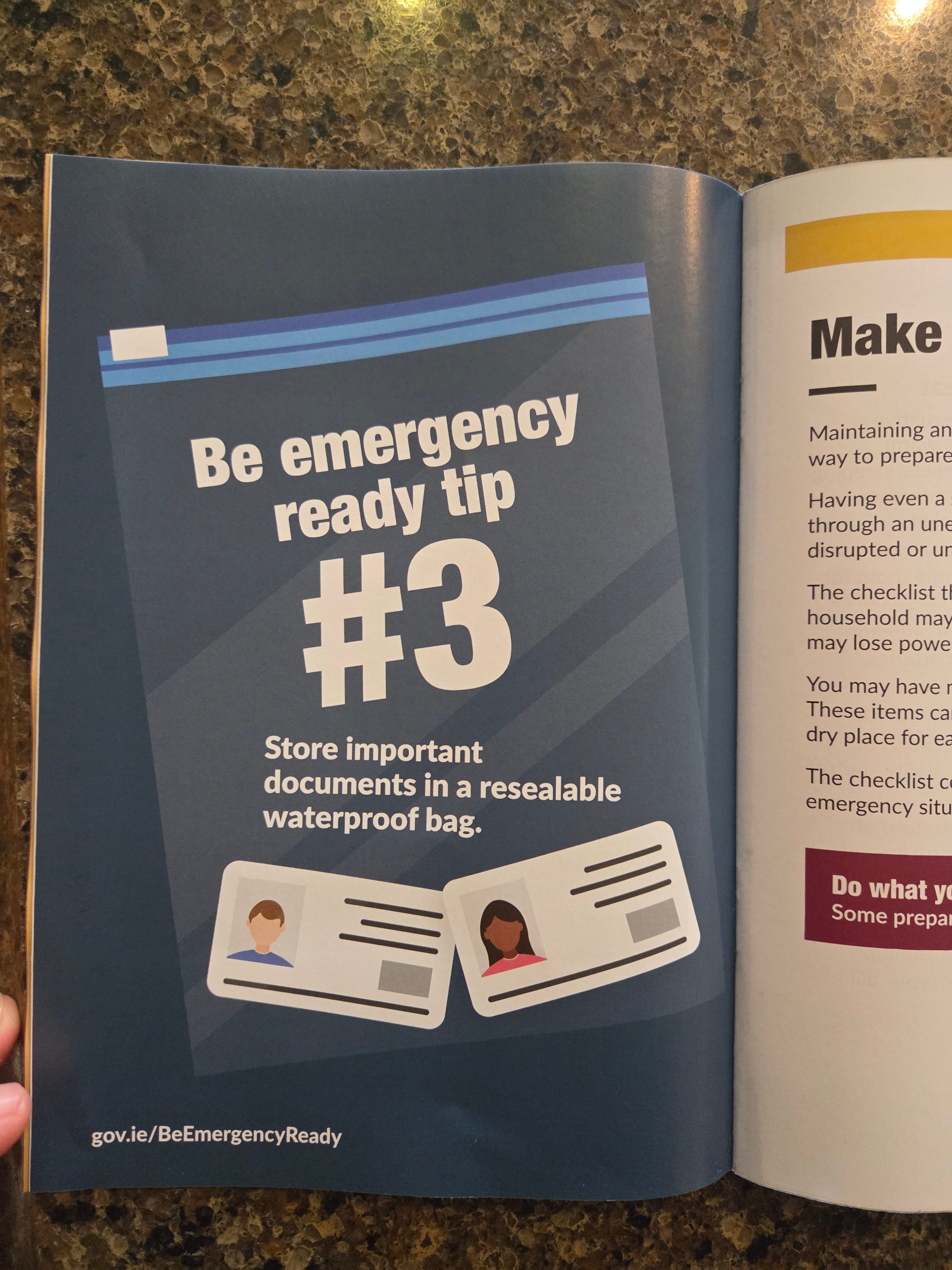
Number 3 advises us that we should store all important documents in a waterproof, resealable bag. What this anticipates, of course, are not our own needs in the aftermath of the apocalypse, but the need for bureaucracy.
Imagine the scene: You’re there with your husband and kids (because obviously, the wife will have the documents) stranded on the roof of your house amidst the rising waters. Finally you see the Irish Navy on the horizon, come to rescue you. And you’ll be allowed on – because your passport will be right there, in a waterproof, resealable bag. They’ll have Sorcha from UCD there to scan the documents for you.
Number 5 might just pip it at the post, however: “Remember”, it counsels us, “Save a photo of your important contact details to your phone”. I’m not joking. That’s seriously what it says.
The others really pale in comparison. Top tip number four is that the number to call if things go wrong is 999. Or 112. Top tip two reminds us to have a supply of food. I’m fine on that score, since I store mine as fat reserves around my gut. Six months or so, right there.
But what, might you ask, is “top survival tip number one”? Dear reader, I am surprised you would have to ask: It is to “keep this booklet somewhere safe in case you need it”. I don’t know about the rest of you, but I’m putting mine in the safe, so I have a record of what number to call when the Zombies surround the house.
I joke, but there’s a serious point here: Whoever wrote this book, and whoever signed off on its publication, thinks that you are an idiot. A fool. A child.
2.2 million copies of this have been printed, plus another 26,000 which will be handed out to local authorities. I cannot, as yet, determine the full cost – but I can tell you that if they used An Post’s Publicity Post service, which facilitates delivery nationwide, then the cost of that alone will have been at least €400,000, conservatively.
The existence of such a publication should be a scandal on a number of grounds, but a lot of people understandably won’t think of all the reasons, or have time to do much more than roll their eyes. So let me list just a few of them, in the spirit of taking the ludicrous Irish state seriously.
First, this booklet contemplates circumstances in which the normal functions of the state are, at the very least, severely impaired. There are certainly emergencies in which shops might be closed, electricity might be out, and roads might be impassable while the phones and emergency services continue to function. But the more serious the emergency envisaged, the less useful much of the advice becomes.
If we are genuinely at the point where households need to survive for an extended period without normal supplies or services, being reminded of the number for 999, or to photograph your contact details, is not much of a survival strategy. Why someone would need their important documents in such a scenario is beyond me.
In such a world, the survival skills listed in this booklet are hopeless. The state would be much better advised to put together a booklet on how to hunt and cook rabbits, or how to start a fire using twigs.
In this sense, it’s the iodine tablets, mark II: By the time the nuke has gone off, the iodine is not going to save you.
Second, the state is providing mostly obvious advice on what citizens should do in an emergency, while rather less attention appears to be paid to what the state itself would be capable of doing in one. In an emergency on the scale contemplated, large-scale rescue operations would be required. I joked above about the Navy coming to save your family: The state has only a tiny number of naval vessels available for operations at any given time.
There is something slightly rich about a state with serious deficiencies in its own emergency and defence capacity sending everybody else a leaflet telling them to keep a few tins in the cupboard.
Only third is the sheer waste involved. The state has an emergency text alert system. Should an emergency come, much of this information could be delivered to every functional phone in the country – and if it cannot be, then the 999 advice and the storing contact numbers advice is itself of limited use.
I cannot yet put a firm figure on the total cost, and it would be wrong to pretend otherwise. But once design, printing and nationwide delivery are included, this is plainly not a trivial exercise. Would a website not have sufficed? They could even have tested the emergency text system to give people the web address, and tell them to print their numbers off from there, or whatever.
Fourth and finally, there’s the insult to our collective intelligence. We are governed by people who think that we do not know to call 999, and that we do not customarily store the phone numbers of our loved ones on our phones.
Remember that when they show up asking for your votes. The Minister responsible for this leaflet should be made to answer for it.
And you won’t be surprised to learn which Minister it is: Helen McEntee.
JMG
SO glad this was written about! 😆
Prepping was considered a far right talking point not long ago