

They say that anecdotes are not data, but there are times when the anecdotes and the data line up. Last week, I was talking to a person in their middle twenties who is presently studying in London, and who had been home for the summer.
What struck her, she said, was how many of her former school and college friends from Ireland were still – at the ages of 25, 26, and 27 – living at home with their parents. Of her own close friend circle, she was the only one who was not. For everyone else, ranging from those with good jobs at the start of lucrative careers in law and accounting, to those working a job in the local Tesco, the idea of living on their own or with a partner simply is not a runner.
Then this week, the CSO’s immigration figures were released.
Confession: I’ve never been a data whizz like Nick Delehanty, or my former colleague Matt Treacy. I’m not able to dig into the numbers and tell you that there are 2,000 more Sri Lankans in Waterford than there were six years ago. You can go elsewhere for that.
But the numbers were stark enough this week that even a fool could read them. Look at the highlighted blue line in the top row, stolen from NWL on twitter:
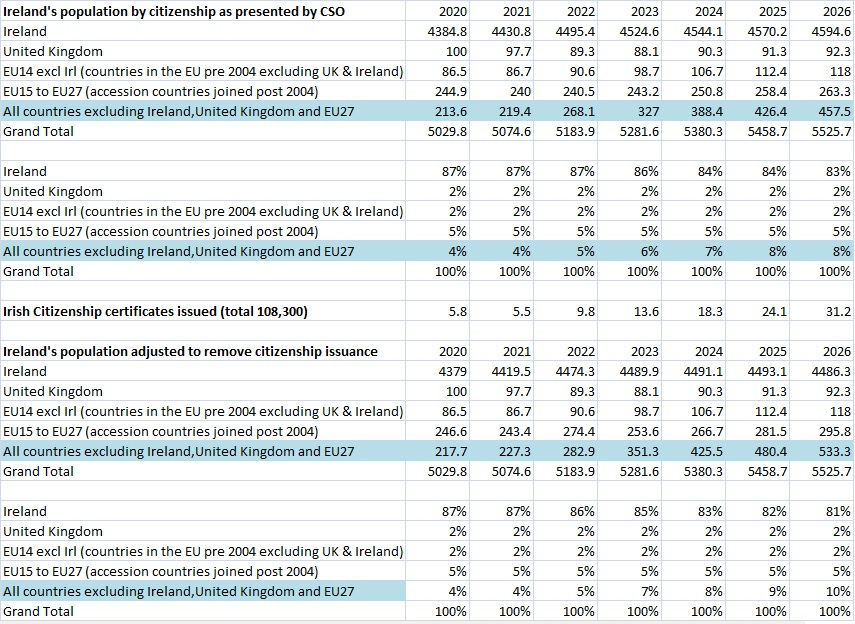
That number – an official state figure – shows that the population of non-EU nationals living in Ireland has increased by more than double, or about 240,000 people, in six years. The number of Irish citizens, meanwhile, has increased by about 200,000, but this presumably includes about 100,000 people originally from elsewhere who have been handed a passport at one of those “citizenship ceremonies” that the Irish Times finds so heart-warming and pure.
Overall, then, the population has increased by about half a million in six years, of which, per the figures, 338,000 is entirely due to migration.
In that same time, according to CSO data, Ireland’s housing stock has increased by about 180,000.
Consider those figures: If you were to strip out immigration, Ireland would have built about 180,000 homes for – at the upper end – 200,000 new residents. But with immigration, it is 180,000 homes for half a million. And that, in sum, is the blatantly obvious reason why so many young people in their twenties are living at home with mam and dad. The silently homeless, we might call them.
It’s therefore obvious, as it has been for many years now: Ireland’s housing and immigration crises are inextricably linked: In fact, the immigration crisis is the housing crisis – despite opinion pollsters always separating them out as if they were two separate things. When you read, as you will, that “housing is the top issue for voters”, remember that housing really means immigration, but politely.
Another thing should be obvious also: That much of the non-EU immigration is, in fact, perfectly legal and being actively facilitated by policymakers. A great portion of it is, as anybody with eyes can see, from the Indian subcontinent, with work and study visas being handed out like candy to people from that part of the world.
Now, confession: I know quite a few Indians living in Ireland and they are, uniformly, law-abiding and decent people who have a deserved reputation internationally for being “good immigrants”. Aside from the odd case, you don’t tend to find Indians over-represented in the criminal justice system. But that doesn’t change the fact that the country does not have room for them.
One big reason for all the legal immigration is, of course, out of control Government spending. The state is now so reliant on corporate tax hauls from American multinationals that in essence, when it comes to recruiting foreign workers, these companies are being allowed write their own visas (figuratively, not literally) and import as many foreigners as they need. The alternative that politicians fear is that those companies might leave and suddenly the state would need to find an alternative source for the billions it is currently spending.
This is the problem, then: For all that many of us would like to have a Government that would immediately get control of immigration, few of us have embraced the costs – because there would be costs. One of them would be starving the most important part of our economy (in terms of the tax revenue produced) of workers.
That is why we must understand that all of these problems are intrinsically connected and do not stand alone: The state spends too much, in part trying to build houses. So the state needs ever more tax revenues. So the state needs ever more migrant workers. So the state needs more houses… All of it is one big circle. You can’t just solve one part of the circle.
But this entire cycle of enormous government leading to enormous population and spending inflation has a real cost: It is the lives of the twenty-somethings that are on pause, unable to get out from under their parent’s roofs and start their own lives and start their own families.
That, in turn, brings down the birth rate dramatically because these young people cannot have children, or must defer them – which leads to…. More immigration.
This is the immigration doom loop that Ireland is stuck in. It can, should, and must be solved, even though solving it will come with economic pain in the short term and likely international ostracization at EU level. I’ll be frank: it does not, actually, need some massive campaign of “re-migration” and the mass deportation of hundreds of thousands, much as that will annoy some people.
What it needs is the door shut, now, and the slow and gradual and manageable enforcement of repatrations as visas expire. The objective of Irish policy should be to slowly reduce the population by 2-300,000 over the next five or six years. Doing so would be transformative for those currently in need of a home, and those denied opportunities.
It’s that, or a great many people in their 20s will wait for a home until their parents die, and they wrestle it from their siblings in one of those family will dramas that we Irish love so much.
A depressing vista, on foot of a depressing set of figures.
We should start with halting illegal immigration especially the bogus asylum seekers. Anyone who comes here via the North, by ferry, or by plane from a peaceful country, is not fleeing war or persecution .. they are shopping around for the best deal they can get. We should also make deportation a mandatory part of any criminal conviction a migrant accrues in this country. Everyone needs a place to live regardless of their status in life .. priority should be given to the lawful.
Great writing, as always. I disagree somewhat that there is a big trade-off needed. Three companies pay half our corporation tax. We can keep them happy with whatever immigration they need without having to import tens of thousands. The big one is making our healthcare system self-sufficient.
I agree that Indian immigrants are generally good, but there is no doubt that they contribute to a feeling of foreignness in Ireland. In particular, I have found their customs with regard to body odour most unpleasant. It doesn’t sit well with me that they have become our second-largest immigrant group in the blink of an eye.
Dan O’Brien was interviewed on Morning Ireland this week. He said, “But again, just the scale of these things in recent years. This was the fifth consecutive year that more than 100,000 people emigrated into the country. The past five years have been utterly unique in Irish history…”
Audrey Carville replied, “But net migration was 48,100, which when you consider all the discussion and all the debate over immigration…is a small number,” that last bit said in a tone of exasperation.
48k is over 600k in British terms, which Britain has only ever exceeded twice. It is a huge number in the middle of a housing crisis, and it shows how deluded our establishment is that Carville could be so confidently wrong.