

One of the strange things about Ireland’s debate on the so-called “Triple Lock” is how one-sided it is, in terms of the noise each “side” makes.
If you were to average the last four public polls on the issue, as I’ve done below (thanks, ChatGPT, for the nice graph) then you’ll find that it’s nowhere near as clear cut as one might think, observing the online debate:
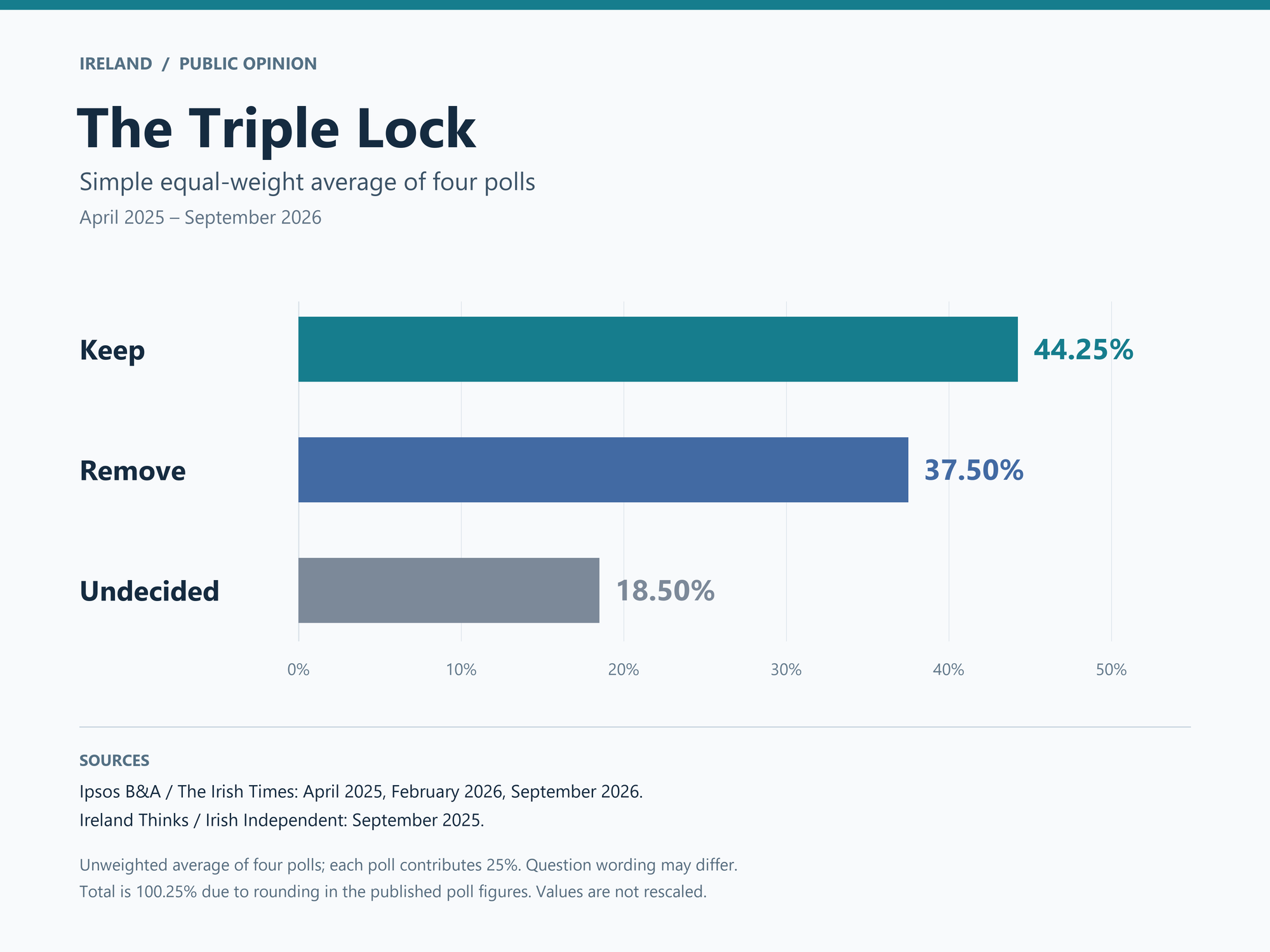
That’s not a massive gap, despite activist sentiment online, in public, and on the media being, by and large, wholly against any decision to change the policy. In fact, it genuinely makes me wonder why the “keep the triple lock” side are so eager for a referendum, given that they are already disproportionately vocal on the issue but nevertheless manage only a small lead over the opposite position.
As readers may know, I myself am an absolute heretic on the issue, by the standards of the so-called “nationalist right”. My view is that a nationalist country (or any country for that matter) should not be granting other countries’ vetoes over what it does with its army.
But I confess I also get annoyed by the tenor of the debate: I noticed one person, the other day, taking to his social media platforms to essentially link the Triple Lock to Irish participation in a Nuclear Armed conflict. Go online, search for discussion of this issue, and you’ll not take long to find an online warrior of right or left preaching with great confidence that the Government’s plan is to send Irish sons and daughters to the front line in Ukraine to take on the good-guy Russians.
None of those things are reasonably foreseeable. They are, by and large, the products of feverish imagination.
What’s more, there’s this idea out and about that neutrality and the triple lock keeps our soldiers safe. That doesn’t stand up to much scrutiny, to be honest: Consider that Portugal, which was a founding member of NATO, lost precisely two soldiers during its 16-year deployment to support the US mission to Afghanistan. Ireland, meanwhile, has suffered five deaths in the Lebanon during the same period.
Now, there might be an ideological argument that says we don’t want to send our troops to Afghanistan (and no such proposal is on the table) but it’s hard to definitively say that similarly sized countries fare worse, in terms of the safety of their soldiery, for being in NATO.
In fact, there’s a reasonably strong argument that our troops would do better, embedded and enmeshed in an alliance, than they do by themselves at the mercy of Hezbollah in southern Lebanon.
But most of all, online, you will find the bizarre argument that the Triple Lock should be kept because Irish people should not trust their Government, or their Dáil (the two other “locks” in the Triple lock arrangement).
First of all, this is a silly basis for keeping the Triple Lock, for the simple reason that any Government could abolish it, at any time: Say Micheál Martin really did want to send 5,000 Irish lads to the front lines in the Donbass: He could abolish the Triple Lock in a single day’s parliamentary sitting, given the rigidity of Ireland’s whip system.
Since no referendum is required, the Triple Lock isn’t really a lock at all.
But second, it’s just bad, in my view, to be arguing that other powers should have power over your own country because you do not trust your own government. Is Beijing more trusted with Ireland’s soldier’s lives than Dublin? Is Moscow? London? Paris? Washington?
At least the lads in Dublin are answerable to Ireland’s voters in theory, even if not always as much as we would like in practice.
Finally, I’d note something else: Switzerland is Neutral. Switzerland has maintained Neutrality for over a century, despite being bordered by an at-times Imperialist France, Austria-Hungary, and Germany both in its Kaiser and Nazi eras.
It has managed to be neutral without ever giving its neighbours a veto over where it sends its troops.
If the Swiss don’t need to do that, then Ireland doesn’t need to do it either. I’m always a little baffled, if I’m honest, that this is even an argument. Especially one made by self-described nationalists.
But by all means, tell me why I am wrong!
J.
I do not disagree with you John but there is something extremely unsettling about this. If Peacekeeping missions are no longer going to be approved by the UN and if our Government succeeds in removing the Triple Lock and if it then decides to send Irish soldiers on a peace Enforcement mission and if tragically there are Irish casualties, when our soldiers bodies return to Ireland, this Government will be known and remembered as the one that removed the Triple Lock. Why hasn’t Ireland been more like Switzerland? Why hasn’t Ireland offered to be a place where conflict resolution discussions can take place? When Micheál Martin or Helen McEntee speak about conflict, be it in Ukraine or elsewhere, they always sound as if they are just saying what they are told to say, with zero conviction to speak up for peace, diplomacy or resolution. Triple Lock or no Triple Lock, that is surely what a neutral country should be doing?
In a world where the Irish government and political class could be trusted to put Irelands interest first and strive for the betterment of their own citizens the Johns argument makes perfect sense. We are not in that world. The world we inhabit is one in which the government for whatever reason endlessly and visible acts against the interests of it's own people. In fact they show every sign on both hating and fearing us in equal measure. In the circumstances in which Ireland finds itself I wouldn't trust the Irish government to run a bath let alone act in Irelands interest.